Anorexia Statistics: What the Data Shows About a Widely Misunderstood Illness


- Anorexia nervosa statistics can shed light on how common this eating disorder is and who it can affect.
- The condition affects people of all ages, ethnicities, and body sizes, and a person does not have to “look sick” to need professional treatment for anorexia nervosa.
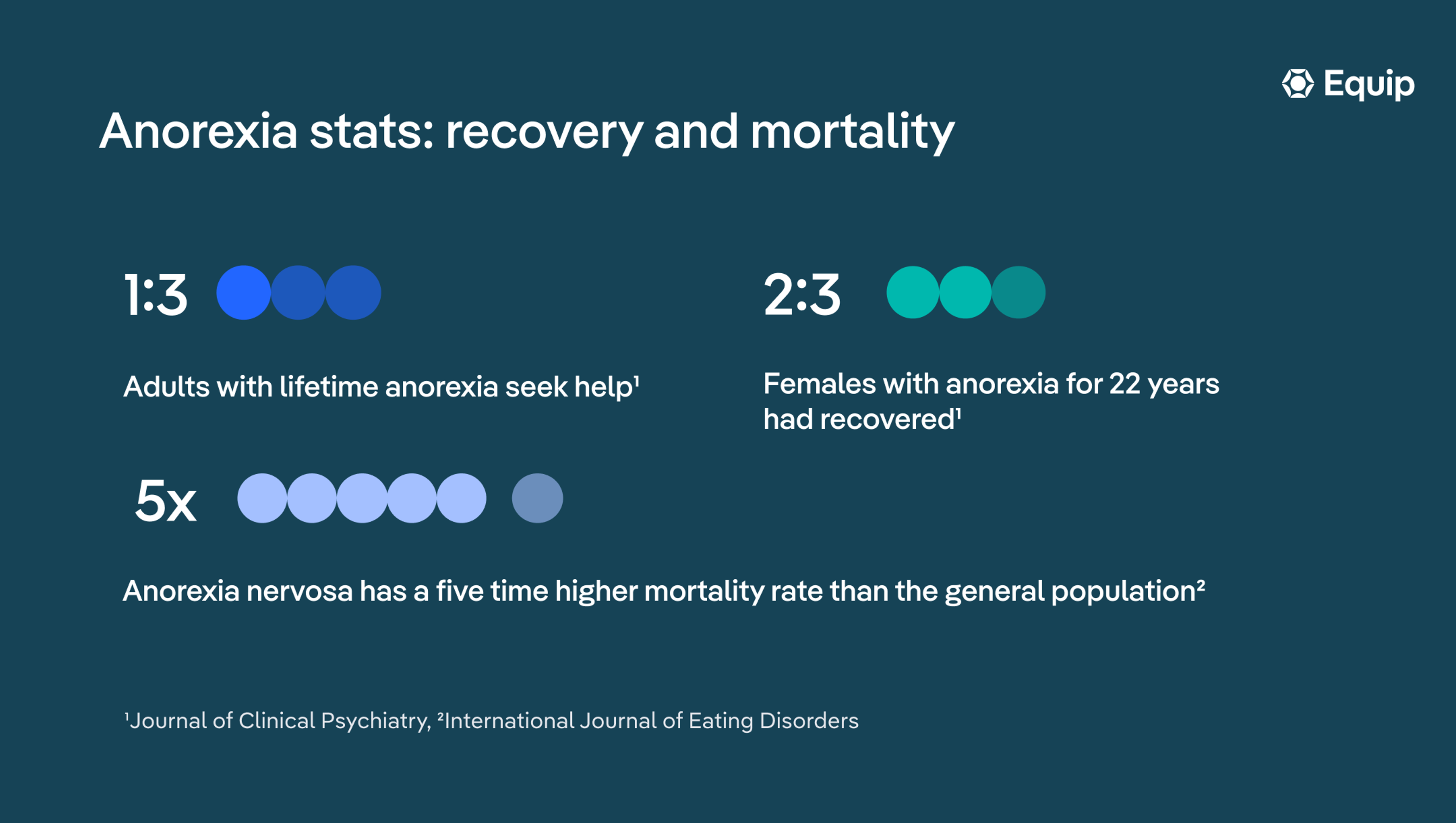
- Although treatment and recovery can take time, estimates show that about two-thirds of patients recover from anorexia
- Although anorexia nervosa is a serious condition that can lead to complications, care is available and recovery is possible.

If you’re concerned about yourself or a loved one having a potential eating disorder, or if you’re a student or journalist writing about the topic, you might be wondering about anorexia statistics, such as how common the condition is and who it affects.
Anorexia nervosa is one of the most well-known eating disorders, but it is also one that is highly misunderstood. Inaccurate or oversimplified beliefs about anorexia are common, including misconceptions about who it affects, what causes it, and how it differs from bulimia nervosa.
The statistics tell a different story than the stereotype, which often perpetuates the idea that the condition only affects young, thin, affluent white females. In reality, the condition affects people of all races and ethnicities, shapes and sizes, all sexes, and nearly all age groups.
In this article, we explore the prevalence of anorexia nervosa across various demographics to share a better picture of the condition’s wide-reaching effects.
Anorexia prevalence statistics: How common is anorexia?
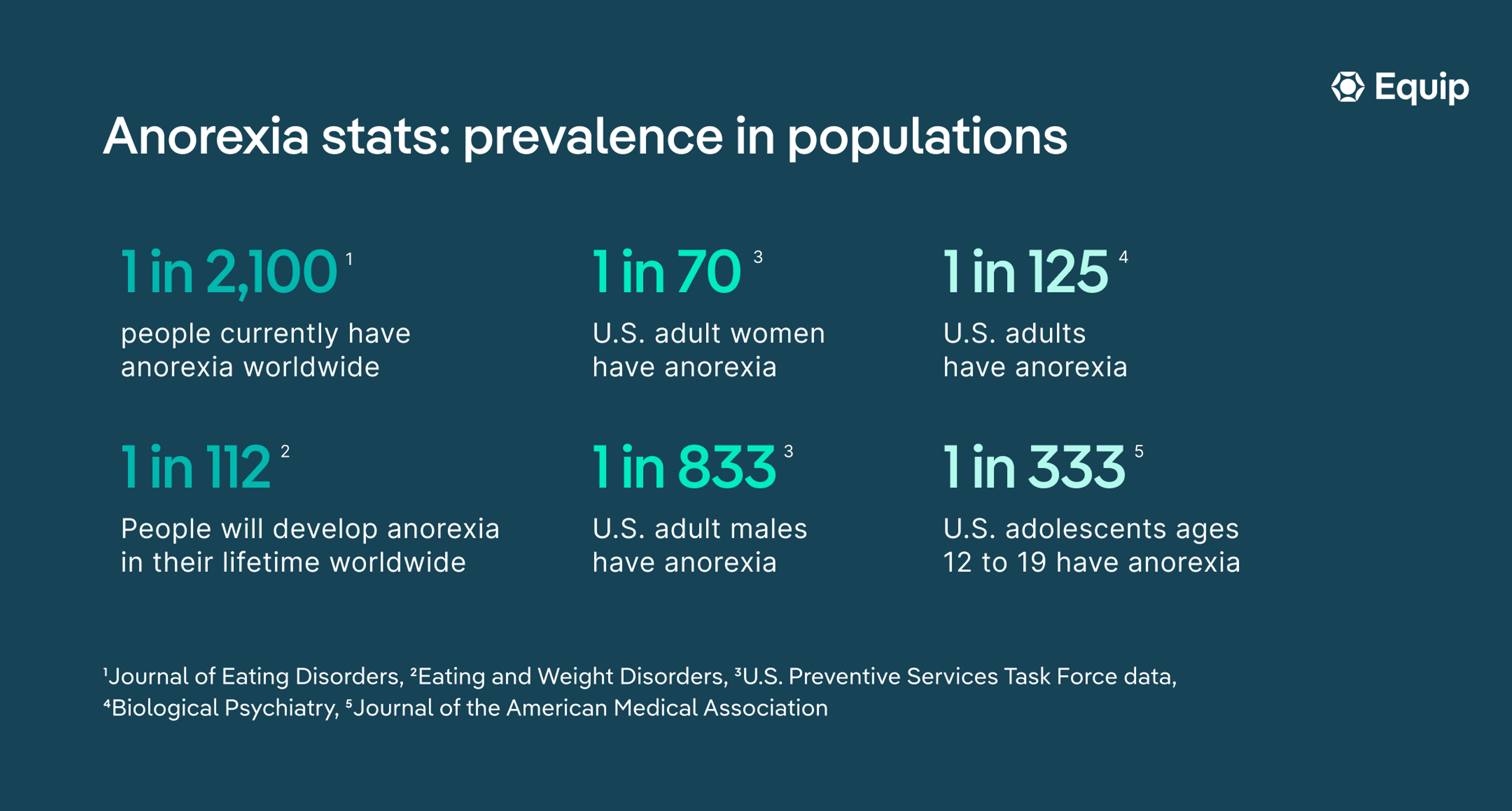
About 1 in 2,100 people (or 0.048%) around the world have a diagnosis of anorexia nervosa at any given time, and about 1 in 112 people (0.89%) will be diagnosed with the condition in their lifetime. Although anorexia is one of the most recognized eating disorders, it is not the most common.
Anorexia statistics worldwide:
- Global prevalence of anorexia nervosa: The most recent prevalence of anorexia nervosa worldwide is 0.048%. This means that about 1 in 2,100 people had this diagnosis as of 2021, according to research published in 2025 in the Journal of Eating Disorders, which looked at trends in anorexia nervosa from 1990 to 2021.
- Global lifetime prevalence: The approximate lifetime prevalence of anorexia nervosa worldwide is roughly 0.89%, which means that about 1 in 112 people worldwide will be diagnosed with anorexia nervosa at some point in their lives. This statistic appears in a 2021 article in the journal Eating and Weight Disorders. It specifically looks at cases of anorexia nervosa that meet the diagnostic criteria outlined in the Diagnostic and Statistical Manual of Mental Disorders 5th Edition (DSM-5 TR), the guide that clinicians use to help diagnose eating disorders and other mental health conditions.
The true number of people affected by anorexia nervosa is likely higher than these estimates, since the condition often goes undiagnosed. The unfortunate reality is that many eating disorders go undetected, and less than 20% of people with an eating disorder receive treatment for their condition, according to a 2024 research article in the British Journal of Psychiatry.
Additionally, atypical anorexia, a condition in which a person has all the symptoms of anorexia but is not underweight, is not reflected in the statistics above. Because atypical anorexia is widely unknown and underrecognized, its prevalence isn't known, but estimates range from 0.15%-13%, according to the International Journal of Eating Disorders.
Is anorexia becoming more common?
Over the past few decades, anorexia nervosa has seen a slight increase in cases. In the trend analysis above, you can see the changes in prevalence from 1990 to 2021, with an increase of about 2.43 people with anorexia nervosa per 100,000 people, about a 5.4% increase overall.
- In 1990: The global prevalence was about 1 in 2,200 (0.45%)
- In 2021: The global prevalence was about 1 in 2,100 (0.48%)
Future studies that look at the more recent prevalence of anorexia nervosa may show a sharper increase in prevalence. Eating disorders overall have increased worldwide by about 40% among children and adolescents (ages 6 to 18) from 2018 to 2022, a timeframe that includes the height of the COVID-19 pandemic, according to 2023 research in the Journal of Pediatrics.
Anorexia demographic statistics: Who does anorexia affect?
Anorexia nervosa affects people of all ages, sexes, body sizes, and races or ethnicities, despite the prevalent stereotype that it only impacts young, thin, white females.
“It’s misleading because it’s inherently false,” says Carol Brown, LCSW, a therapist at Equip. “Many of the patients I work with fall outside those stereotypes and are struggling with anorexia that is just as real and just as dangerous as [for] an individual who does fit that stereotype.”
The stereotype can also show up within the healthcare system, with many providers lacking knowledge about proper assessment and care.
“I've had so many patients whose symptoms were not recognized or even dismissed because they didn’t fit that stereotype, leading to delays in seeking care and the reinforcement of the thoughts of ‘I’m not really sick,’” Brown says.
Age of onset
Anorexia can affect anyone at any age, though it appears to be more common in adults than in children. Overall, the lifetime prevalence for anorexia nervosa in the United States for adults is 1 in 125 (0.8%). For adolescents (ages 12 to 19), the prevalence is 1 in 333 (0.3%).
- U.S. lifetime prevalence in adults: 1 in 125 adults in the U.S. will be diagnosed with anorexia nervosa in their lifetime, according to research published in 2018 in the journal Biological Psychiatry, which looked at nationally representative data from 2012 to 2013.
- U.S. lifetime prevalence in adolescents: 1 in 333 adolescents between 12 and 19 will be diagnosed with anorexia nervosa, according to a 2022 U.S. Preventive Services Task Force report published in JAMA, the journal of the American Medical Association.
Ready to take the first step?
When looking at younger populations in the United States, one of the most common age ranges of anorexia nervosa onset is from ages 19 to 24, according to research published in the International Journal of Eating Disorders in 2022. Of course, this age range often coincides with leaving home after high school and either pursuing secondary education or a first full-time job — a time of major change and various pressures, which can make it high-risk for onset or relapse. The researchers explored a representative sample of people diagnosed with anorexia before age 25 and categorized them by their age of onset.
Age of onset for young people diagnosed with anorexia nervosa:
- Anorexia in childhood (ages 14 and younger): ~12%
- Anorexia in teens (ages 15 to 18): ~40%
- Anorexia in emerging adults (ages 19 to 24): 49%
Sex
Anorexia nervosa affects people of all sexes and gender identities. In the United States, the lifetime prevalence is higher in adult females, with 1 in 70 (1.42%) developing the condition at some point in their life. By comparison, the lifetime prevalence for adult males is 1 in 833 (0.12%), according to U.S. Preventive Services Task Force data.
Keep in mind that these statistics likely don’t reflect the complete picture for males. “Anorexia in males is often underrecognized and underdiagnosed because they don't fit the anorexia stereotype,” Brown says. “Because of this perception, males struggling with anorexia may experience more shame and opt not to seek care.”
She adds, “[male anorexia] is also similarly underrecognized by providers and the public at large. For some males, anorexia may show more as a preoccupation with being muscular or fit, which also may lead to it being underrecognized and reported.”
These statistics also don’t reflect prevalence for transgender and nonbinary people. Separate research from 2020 shows that more than 4% of transgender people have anorexia nervosa.
Race and ethnicity
Eating disorder statistics show that the prevalence for eating disorders overall is similar across racial and ethnic groups, according to a 2025 study published in the International Journal of Eating Disorders.
Focusing on anorexia nervosa specifically, the researchers used a sample of nearly 30,000 U.S. college students, with about 10,000 males and 20,000 females. They looked at probable anorexia by race/ethnicity and found that anorexia is likely the most prevalent in Asian populations, followed by multiracial populations. However, the condition can affect anyone of any race or ethnicity, and the statistics may not reflect the full picture of anorexia nervosa across races, because stigma may be a barrier to receiving a diagnosis or care.
Prevalence of probable anorexia nervosa by race/ethnicity
Race/ethnicity | Cisgender females | Cisgender males | Non-cisgender |
Asian | 3.61% (1 in 28) | 0.62% (1 in 161) | 8.64% (1 in 12) |
Multiracial | 2.50% (1 in 40) | 0.52% (1 in 192) | 3.28% (1 in 30) |
White | 2.41% (1 in 42) | 0.41% (1 in 244) | 1.53% (1 in 65) |
Hispanic | 1.86% (1 in 54) | 0.47% ( 1 in 213) | 2.40% (1 in 42) |
Black | 0.56% | 0.00% | 0.00% |
Body size
One widespread misconception about anorexia nervosa is that you can tell if someone has it by looking at them, but people of all sizes and shapes can develop the condition. When someone has all the symptoms of anorexia nervosa but isn’t underweight, it’s known as atypical anorexia.
“Often the misperception of anorexia is that thinness has to be present for it to be anorexia,” Brown says. “However, this is untrue and another harmful stereotype. This illness does not discriminate based on body shape or size.”
She notes that the key clinical symptoms of anorexia include an intense fear of weight gain, significant restriction of energy needs, and a disturbance in perception of body weight or shape. “Restricting energy intake can significantly impact an individual’s day-to-day functioning and lead to equally serious health risks, regardless of their weight or shape,” Brown adds.
As with anorexia people of any age, race, sex, or gender identity can develop atypical anorexia. At Equip, we refer to atypical anorexia as simply anorexia. Differentiating the two perpetuates the idea that one is less serious than the other, but the reality is that both carry serious risks and require the same treatment.
Anorexia risk statistics: How serious is anorexia?
The risks of untreated anorexia are serious. The anorexia mortality rate is one of the highest among psychiatric disorders, according to 2026 research published in the International Journal of Eating Disorders. People with anorexia have 5 times the mortality rate of people in the general population.
Although anorexia comes with many risks to someone’s overall health, two of the most dangerous ones are suicidal thoughts or actions and heart problems. These two causes account for 21% and 19% of anorexia nervosa deaths, respectively.
However, just because anorexia is a serious condition with serious risks does not mean the situation is hopeless. Help is available and recovery is possible for anyone with anorexia nervosa.
Anorexia treatment and recovery statistics: How treatable is anorexia?
If you suspect that you or a loved one has anorexia nervosa, seeking help is crucial‚ but not everyone takes this step.
Only about 1 in 3 (34.5%) U.S. adults with lifetime anorexia seek help for their condition, according to research published in Mayo Clinic Proceedings in 2019.
Recovery can take time, but it is possible. Exact anorexia recovery rates are hard to pin down. But one study, published in the Journal of Clinical Psychiatry in 2017, found that after a 22-year follow-up, nearly two-thirds (62.8%) of females with an anorexia nervosa diagnosis who were followed during the study had recovered.
Don’t delay seeking help out of feeling you’re “not sick enough.” This is a common misconception Brown encounters. “Eating disorders are highly competitive in nature,” she explains, “so when a patient with an eating disorder perceives that someone is ‘sicker’ than them or ‘looks the part’ of anorexia, they often hesitate in seeking care or find themselves minimizing their symptoms.”
Early intervention can make a huge difference in treatment and recovery, while delays can make the process more challenging, but still possible. “Long-term risks of malnutrition also become more serious when treatment is delayed,” Brown adds. “Unfortunately, I've worked with many patients who have suffered with anorexia for years because they felt they couldn’t possibly be sick because they weren’t young, white, and thin.”
No matter how long you or a loved one have been struggling, recovery is possible, and professional support can make all the difference.
The bottom line
Anorexia nervosa is a well-known but misunderstood eating disorder. Although stereotypes depict the condition as mostly affecting young, underweight, white females, in reality anorexia nervosa can affect just about anyone, and thinness isn’t always a feature.
Although it has a high rate of complications and mortality, recovery is possible and within reach for anyone struggling. Informed eating disorder care is just a phone call away. Reach out to Equip for a consultation.
FAQ
Is anorexia the deadliest mental illness?
Anorexia nervosa has the highest mortality rate when compared with other psychiatric disorders. However, treatment is available and recovery is possible, though it may take time.
Are eating disorders becoming more common?
Yes, eating disorders are on the rise globally, especially among children and adolescents.
What is the average age of onset for anorexia?
The most common age range of onset for anorexia nervosa is between ages 15 and 24.
Coffino, Jaime A., et al. “Rates of Help-Seeking in US Adults with Lifetime DSM-5 Eating Disorders: Prevalence Across Diagnoses and Differences by Sex and Ethnicity/Race.” Mayo Clinic Proceedings, vol. 94, no. 8, Aug. 2019, pp. 1415–26.
Eddy, Kamryn T., et al. “Recovery From Anorexia Nervosa and Bulimia Nervosa at 22-Year Follow-Up.” The Journal of Clinical Psychiatry, vol. 78, no. 02, Feb. 2017, pp. 184–89.
Feltner, Cynthia, et al. “Screening for Eating Disorders in Adolescents and Adults: Evidence Report and Systematic Review for the US Preventive Services Task Force.” JAMA, vol. 327, no. 11, Mar. 2022, p. 1068.
Grilo, Carlos M., and Tomoko Udo. “Examining the Significance of Age of Onset in Persons with Lifetime Anorexia Nervosa: Comparing Child, Adolescent, and Emerging Adult Onsets in Nationally Representative U.S. Study.” The International Journal of Eating Disorders, vol. 54, no. 9, July 2021, p. 1632.
Haynos, Ann F., et al. “Not Niche: Eating Disorders as an Example in the Dangers of Overspecialisation.” The British Journal of Psychiatry, vol. 224, no. 3, Mar. 2024, pp. 82–85.
Qian, Jie, et al. “An Update on the Prevalence of Eating Disorders in the General Population: A Systematic Review and Meta-Analysis.” Eating and Weight Disorders - Studies on Anorexia, Bulimia and Obesity, vol. 27, no. 2, Mar. 2022, pp. 415–28.
Howe, Carli P., et al. “Examining Prevalence and Presentations of Eating Disorders Across Racial/Ethnic Groups in a National, Population‐Based Sample of College Students.” International Journal of Eating Disorders, vol. 58, no. 6, June 2025, pp. 1165–77.
Lai, Eric Tsz‐Him, et al. “Systematic Review and Meta‐Analysis of Mortality in Patients With Anorexia Nervosa.” International Journal of Eating Disorders, vol. 59, no. 3, Mar. 2026, pp. 424–49.
Shen, Yi, et al. “Global, Regional, and National Burden of Eating Disorders in 204 Countries and Territories, 1990–2021: Findings from the Global Burden of Disease Study 2021.” Journal of Eating Disorders, vol. 13, no. 1, Dec. 2025, p. 290.
Udo, Tomoko, and Carlos M. Grilo. “Prevalence and Correlates of DSM-5-Defined Eating Disorders in a Nationally Representative Sample of U.S. Adults.” Biological Psychiatry, vol. 84, no. 5, Sept. 2018, pp. 345–54.