The SCOFF Questionnaire: Questions, Scoring, and What It Can and Can’t Do


- The SCOFF questionnaire is a five-question screening tool for detecting potential cases of the eating disorders anorexia nervosa or bulimia nervosa.
- SCOFF is an acronym, with each letter standing for the main topic of each question.
- The questions have yes-or-no answers. Answering “yes” to two or more questions indicates a potential eating disorder.
- However, SCOFF is not a standalone diagnostic tool. It simply serves as a red flag that further evaluation is necessary.

Eating disorders are complex and sometimes hard to detect. If you’re concerned about your eating or exercise patterns or those of a loved one, you might be looking for a quick way to assess the situation or wondering how clinicians approach eating disorder screening.
One tool, used by both clinicians and individuals, is the five-question SCOFF questionnaire. The SCOFF acronym stands for the key topic of five yes-or-no questions. A SCOFF score of two or more “yes” answers indicates the need for further evaluation.
The SCOFF screening tool is a brief assessment for anorexia nervosa and bulimia nervosa. It does not diagnose or eliminate the possibility of an eating disorder. An eating-disorder-informed clinician can offer further evaluation to confirm or rule out an eating disorder and help you determine next steps.
In this article, we explore the SCOFF test and how it is used, the SCOFF questions, and more.
What is the SCOFF questionnaire?
The SCOFF questionnaire is a five-question eating disorder screening tool for assessing whether you or a loved one may have anorexia nervosa and bulimia nervosa. SCOFF involves yes-or-no answers only.
“[It] helps identify whether someone may need a more comprehensive eating disorder assessment,” says Melodie Simmons, DHA, LPC, CEDS-C, a clinical instructor at Equip. “It is a screening tool, not a diagnostic measure.”
What does SCOFF stand for?
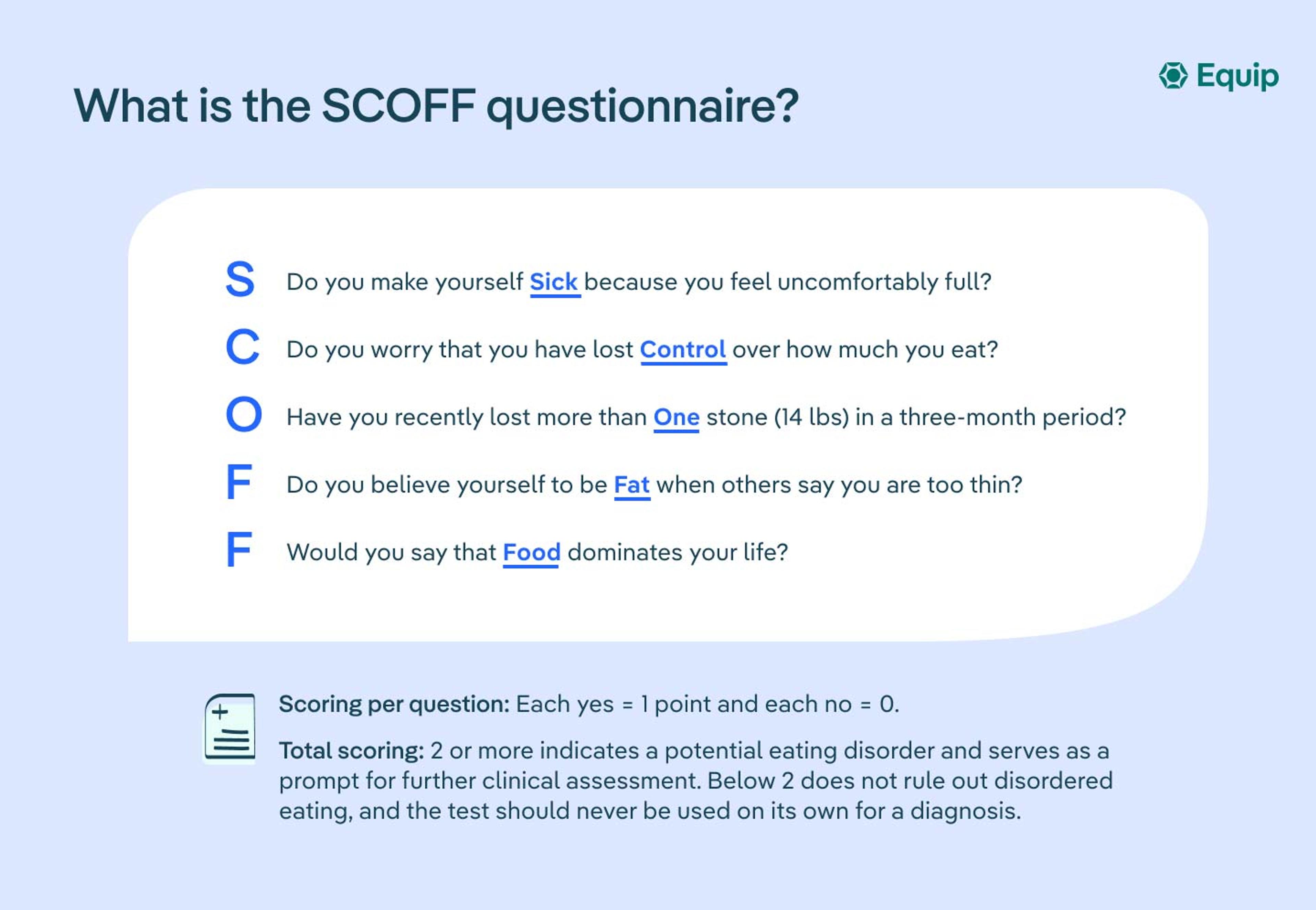
SCOFF is an acronym that stands for Sick, Control, One, Fat, Food. These words represent the key topic of each question the screening tool includes.
- Do you make yourself Sick because you feel uncomfortably full?
- Do you worry that you have lost Control over how much you eat?
- Have you recently lost more than One stone (14 pounds) in a three-month period?
- Do you believe yourself to be Fat when others say you are too thin?
- Would you say that Food dominates your life?
The SCOFF eating disorder screening tool was created in the United Kingdom by researchers at St. George’s Hospital Medical School, which is why you see the “One stone” used as a weight metric.
How is the SCOFF scored?
Each question requires a yes-or-no answer, with a “yes” answer receiving a score of one point and a “no” zero points. A score of two or more points indicates a potential case of anorexia nervosa or bulimia nervosa.
However, a score of two or more points does not automatically mean that you or a loved one (or your patient) has one of these conditions. Additionally, a score of one or zero does not guarantee someone doesn’t have a potential eating disorder or disordered eating behaviors.
“The SCOFF can help identify potential concerns,” Simmons says. “But I would never use the score alone to confirm or rule out an eating disorder. I view a positive screen as a prompt for further assessment, and I would still explore symptoms when clinical concerns are present despite a negative screen.”
Who is the SCOFF for?
The researchers note that the test is most accurate when assessing young females specifically for anorexia nervosa and bulimia. It tends to be somewhat less accurate when assessing males or other demographics for these conditions.
Additionally, the SCOFF questionnaire is not reliable for assessing the full range of eating disorders that are listed in the Diagnostic and Statistical Manual of Mental Disorders, 5th Edition (DSM-5). The DSM-5 lists criteria for clinicians to diagnose mental health conditions.
It features many more eating disorders than just anorexia nervosa and bulimia nervosa, including binge eating disorder (BED), avoidant restrictive food intake disorder (ARFID) and other specified feeding or eating disorder (OSFED).
The researchers who developed the SCOFF questionnaire even note the following in a journal article published in 2000: “We developed five questions addressing core features of anorexia nervosa and bulimia nervosa.”
The SCOFF questionnaire at a glance
Acronym word | Question | Answer | Scoring |
Sick | Do you make yourself Sick because you feel uncomfortably full? | Yes or no | |
Control | Do you worry that you have lost Control over how much you eat? | Yes or no | 1 point for “yes” 0 points for “no” |
One | Have you recently lost more than One stone (14 pounds) in a three-month period? | Yes or no | 1 point for “yes” 0 points for “no” |
Fat | Do you believe yourself to be Fat when others say you are too thin? | Yes or no | 1 point for “yes” 0 points for “no” |
Food | Would you say that Food dominates your life? | Yes or no | 1 point for “yes” 0 points for “no” |
TOTAL: |
How accurate is the SCOFF questionnaire?
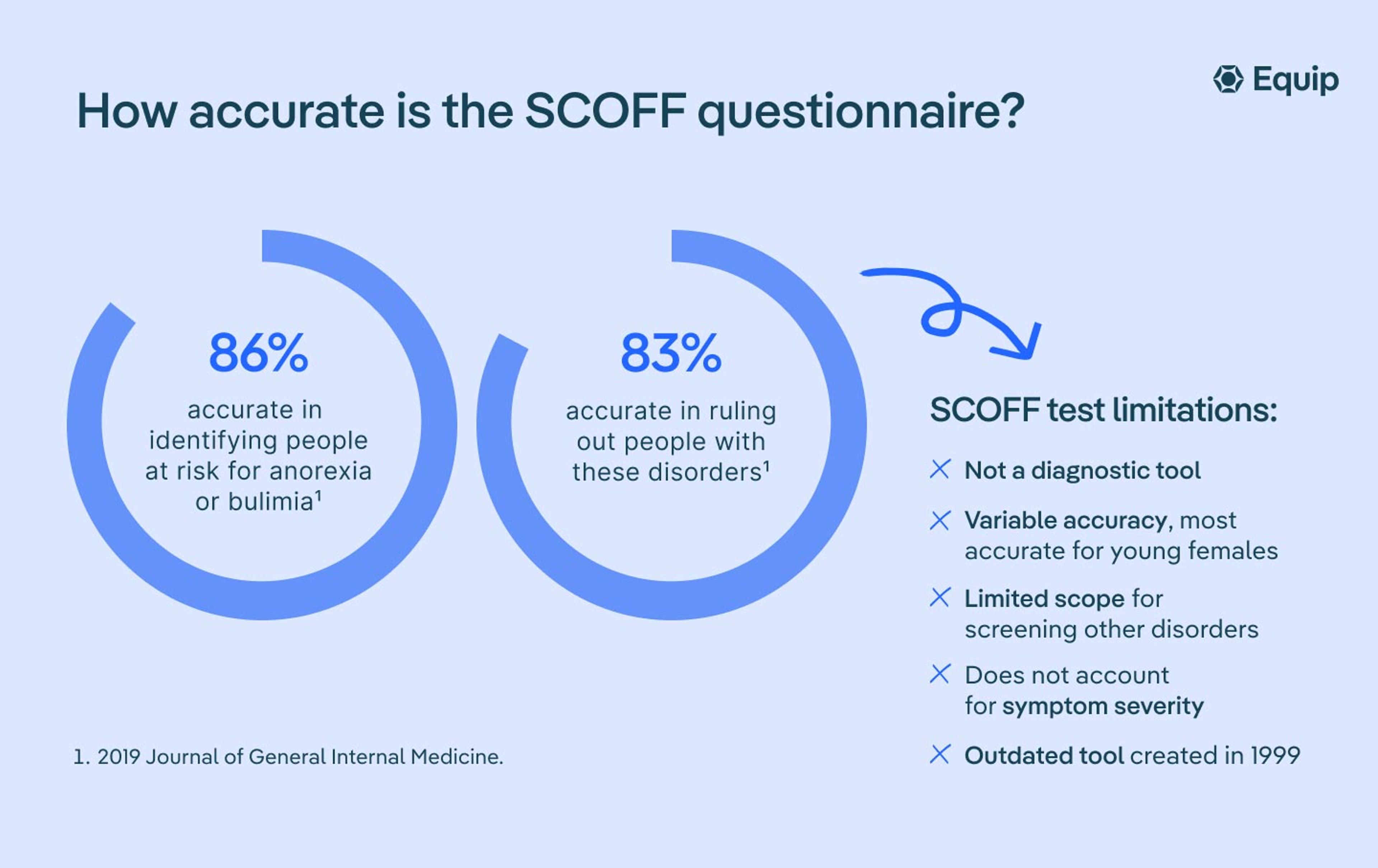
The SCOFF questionnaire is about 80% to 90% accurate for detecting potential cases of the eating disorders anorexia nervosa and bulimia nervosa, according to a 2019 research analysis published in the Journal of General Internal Medicine.
- The test has about 86% sensitivity. This means the SCOFF correctly identifies most people who are at risk for anorexia nervosa and bulimia nervosa.
- The test has about 83% specificity. This means the SCOFF correctly rules out most people who do not have these eating disorders, though false positives do occur.
What the SCOFF can miss
The SCOFF has several limitations, including that it’s not a diagnostic tool, doesn’t assess for the full range of eating disorders, and more.
“A major limitation is its narrow focus,” Simmons says. “The SCOFF is more heavily oriented toward traditional anorexia nervosa and bulimia nervosa symptoms and may not adequately capture the full range of eating disorder presentations. It also provides limited information about symptom frequency, severity, duration, or functional impact.”
SCOFF limitations:
- Not a diagnostic tool: SCOFF is a screening tool, but it cannot confirm or rule out an eating disorder.
- Variable accuracy across populations: SCOFF is most accurate in assessing young females, and it is less accurate at assessing other populations.
- Doesn’t include the full range of eating disorders: SCOFF mainly screens for anorexia nervosa and bulimia nervosa, but many more eating disorders exist.
- Doesn’t assess severity: Although it helps detect the presence of anorexia nervosa or bulimia nervosa, the SCOFF doesn’t account for symptom severity.
- An older tool: SCOFF was created in 1999, and some research suggests it is an outdated tool because of its limitations.
How the SCOFF compares with other screening tools
SCOFF is just one eating disorder screening tool. Other assessments include the Eating Disorder Examination Questionnaire or EDE-Q-S, the Nine-Item ARFID Screen (NIAS), and the Pica, ARFID, and Ruminational Interview Questionnaire (PARDI-AR-Q). Each has its own benefits and limitations.
“I prefer the EDE-Q because it provides a broader picture of eating disorder symptoms than the SCOFF,” Simmons says. However, EDE-Q does not adequately assess for avoidant/restrictive food intake disorder (ARFID).
“When ARFID is a concern,” Simmons adds, “I will consider either a brief screening tool like the NIAS or the PARDI-AR-Q, which offers a more comprehensive look at ARFID symptoms and their impact.”
Comparing eating disorder screening tools
Tool | Number of questions | What it screens for | Best-fit setting | Key limitations |
SCOFF | 5 | Anorexia nervosa and bulimia nervosa | Screening for AN or BN in young females | Does not screen for the full range of eating disorders and variable accuracy across populations |
EDE-Q-S | 12 | The presence, frequency, and severity of attitudes and behaviors related to eating disorders | Screening for ages 14 and over; performs well across diverse body weights | The screener relies on a 7-day window, self-reported validation data, and predominantly female young-adult samples; does not adequately screen for ARFID |
NIAS | 9 | Assesses symptoms of ARFID | Screening for ARFID | Does not screen for the full range of eating disorders |
PARDI-AR-Q | 29 to 32 (3 questions are administrative) | Assesses symptoms of ARFID and the psychological drivers of the condition | Screening for ARFID and the presenting characteristics | May miss other eating disorders; does not provide a unified score |
If you’re a clinician who needs to refer a patient who screens positive for an eating disorder, Equip can help you make a referral. You can also download Equip’s screener for medical providers.
The bottom line
The SCOFF questionnaire is a brief, five-item screening tool requiring yes-or-no answers to assess the potential presence of anorexia nervosa and bulimia nervosa.
It does not diagnose or rule out these conditions, however. Instead, a score of two or more “yes” answers indicates the need for further evaluation. However, anyone who is concerned about themselves or a loved one regardless of score, or any clinician concerned about a patient, can benefit from Equip’s free consultation.
FAQ
Is the SCOFF questionnaire still used?
Yes, the SCOFF questionnaire is still used as a brief eating disorder assessment by clinicians in primary care, mental health, and other settings to screen for anorexia nervosa or bulimia nervosa. In some cases, individuals also use it if they're concerned about themselves or a loved one. However, SCOFF does not officially diagnose or rule out eating disorders or disordered eating behaviors.
Can the SCOFF be self-administered?
Yes, you can self-administer the SCOFF questionnaire by answering yes or no to its five brief questions. Two or more “yes” answers is a strong indication to seek evaluation with an eating-disorder-informed clinician. However, even if you don’t have two or more “yes” answers, don’t hesitate to talk to a provider if you have concerns about your behaviors regarding food or exercise. The SCOFF has several limitations, including that it is not an accurate tool for assessing all eating disorders or disordered eating behaviors.
Is the SCOFF equally accurate across sexes?
The SCOFF questionnaire is 80% to 90% accurate in large studies. However, research shows that it is most accurate when assessing young females for anorexia nervosa and bulimia nervosa. It is less accurate at assessing males, people of all ages, and the full range of eating disorders.
Bryant-Waugh, Rachel, et al. “Preliminary Validation of the Pica, ARFID and Rumination Disorder Interview ARFID Questionnaire (PARDI-AR-Q).” Journal of Eating Disorders, vol. 10, no. 1, Nov. 2022, p. 179.
Jenkins, Paul E., and Renee D. Rienecke. “Structural Validity of the Eating Disorder Examination—Questionnaire: A Systematic Review.” International Journal of Eating Disorders, vol. 55, no. 8, Aug. 2022, pp. 1012–30.
Morgan, J. F., et al. “The SCOFF Questionnaire: Assessment of a New Screening Tool for Eating Disorders.” BMJ, vol. 319, no. 7223, Dec. 1999, pp. 1467–68.
Nagata, Jason M., and Neville H. Golden. “New US Preventive Services Task Force Recommendations on Screening for Eating Disorders.” JAMA Internal Medicine, vol. 182, no. 5, May 2022, p. 471.
Presseller, Emily K., et al. “Assessing Avoidant/Restrictive Food Intake Disorder (ARFID) Symptoms Using the Nine Item ARFID Screen in >9000 Swedish Adults With and Without Eating Disorders.” International Journal of Eating Disorders, vol. 57, no. 11, Nov. 2024, pp. 2143–55.