Infographic: Understanding the Eating Disorder-Mental Health Connection


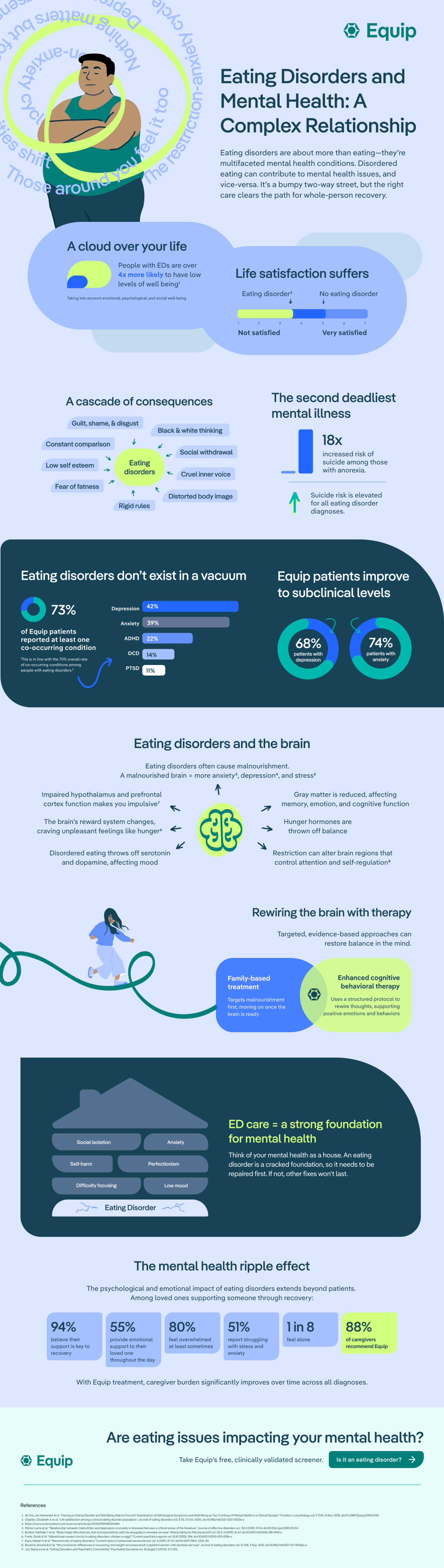
- Eating disorders are not choices or vanity issues. They are diagnosable mental illnesses with complex causes.
- Certain mental health factors can raise the risk of developing an eating disorder; likewise, eating disorders can contribute to other mental health concerns. The relationship is bidirectional.
- Eating disorders affect a person's mental health in several different ways: emotionally, psychologically, and cognitively.
- Treatment requires a whole-person approach. Usually, it's important to address the eating disorder first, as it is difficult to make progress with other concerns when nutritional needs aren't met.
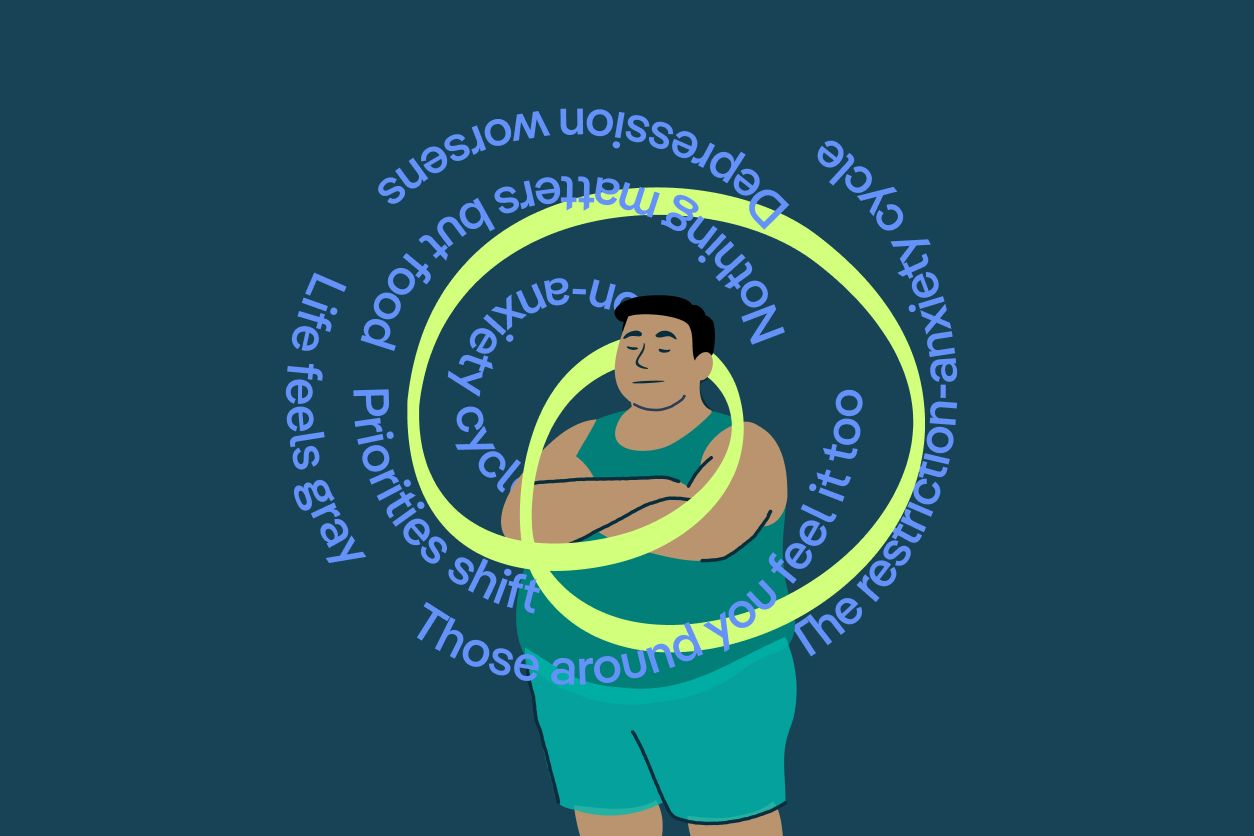
When people think of eating disorders, they often think of certain behaviors (like restricting food, binge eating, or purging) or observable symptoms (like weight changes, lanugo, or frequent injuries). But eating disorders go deeper than what you see on the surface. They are, first and foremost, mental health conditions, and can affect every aspect of a person’s mental well-being.
Not only are eating disorders mental illnesses themselves, but they also have a complex, bidirectional relationship with other aspects of mental health—meaning they influence and are influenced by various different things going on in your mind and brain. In fact, they can shape mental health on several different levels:
Emotional: your feelings and mood
Psychological: your thoughts and state of mind
Cognitive: your ability to focus, process information, and remember
This Mental Health Awareness Month, we’re shining a light on a simple but important truth: eating disorders are mental illnesses—not choices or vanity issues—and need to be part of the mental health conversation. Explore the infographic below to learn about the many ways that eating disorders impact mental health (and vice versa).
Curious to learn more? Here are some more in-depth articles on the topics explored above.
What We Mean By “Eating Disorders Are Brain Disorders”
What's the Connection Between OCD and Eating Disorders?
Eating Disorders and Anxiety: What’s the Connection?
What is the Relationship Between Trauma and Eating Disorders?
The Link Between ADHD and Eating Disorders: What We Know
What's the Connection Between Body Image and Eating Disorders?
Suicide Rates Are Higher in Eating Disorder Populations — Here’s What You Need to Know
New Equip Research: The Experience of Caregivers in Eating Disorder Recovery
de Vos, Jan Alexander et al. “Having an Eating Disorder and Still Being Able to Flourish? Examination of Pathological Symptoms and Well-Being as Two Continua of Mental Health in a Clinical Sample.” Frontiers in psychology vol. 9 2145. 15 Nov. 2018, doi:10.3389/fpsyg.2018.02145
Claydon, Elizabeth A et al. “Life satisfaction among a clinical eating disorder population.” Journal of eating disorders vol. 8 53. 13 Oct. 2020, doi:10.1186/s40337-020-00326-z
Mattar, Lama et al. “Relationship between malnutrition and depression or anxiety in Anorexia Nervosa: a critical review of the literature.” Journal of affective disorders vol. 132,3 (2011): 311-8. doi:10.1016/j.jad.2010.09.014
Burkert, Nathalie T et al. “Body image disturbances, fear and associations with the amygdala in anorexia nervosa.” Wiener klinische Wochenschrift vol. 131,3-4 (2019): 61-67. doi:10.1007/s00508-018-1440-y
Frank, Guido K W. “Altered brain reward circuits in eating disorders: chicken or egg?.” Current psychiatry reports vol. 15,10 (2013): 396. doi:10.1007/s11920-013-0396-x
Kaye, Walter H et al. “Neurocircuity of eating disorders.” Current topics in behavioral neurosciences vol. 6 (2011): 37-57. doi:10.1007/7854_2010_85
Brodrick, Brooks B et al. “Structural brain differences in recovering and weight-recovered adult outpatient women with anorexia nervosa.” Journal of eating disorders vol. 9,1 108. 3 Sep. 2021, doi:10.1186/s40337-021-00466-w
Juli, Rebecca et al. “Eating Disorders and Psychiatric Comorbidity.” Psychiatria Danubina vol. 35,Suppl 2 (2023): 217-220