What Is Orthorexia? When “Healthy Eating” Becomes Harmful
- Orthorexia is an obsession with healthy eating that can lead to anxiety, nutritional problems, and social isolation.
- Orthorexia isn’t a formal DSM diagnosis, but it can be assessed and treated under existing eating disorder diagnoses.
- Diet culture, wellness trends, and social media can normalize rigid food rules, making orthorexia harder to recognize.
- Recovery is possible with the right support, and you don’t need an orthorexia diagnosis to get help.

Orthorexia is a harmful obsession with eating foods perceived as “healthy,” “clean,” or “pure.” Unlike simply caring about nutrition, orthorexia involves rigid food rules that can cause significant anxiety, interfere with daily life, and negatively influence physical and mental health, according to the journal Appetite.
For Equip Peer Mentor Rachel Myers, it started with what she calls “health anxiety.” Fear of getting sick or developing a chronic illness led her to explore ways to protect her health, eventually leading her to veganism. But over time, that pursuit of healthy eating became increasingly obsessive and took a toll on her well-being.
Experiences like Myers’ can be difficult to recognize as problematic, especially in a culture that praises discipline and self-control around food. Here's what to know about the signs of orthorexia, what causes it, and how to find support.
What is orthorexia?
Orthorexia is a pattern of disordered eating in which a fixation on food quality or purity becomes so rigid that it interferes with everyday life. Physician Steven Bratman coined the term in 1997, combining the Greek words “orthos” (correct) and “orexis” (appetite).
“When we talk about orthorexia, we’re referring to the state of being rigidly obsessed with 'clean' eating patterns in a way that obstructs normal functioning and daily life,” says Equip dietitian Gabriela Cohen, MS, RD, LDN.
This might mean cutting out entire food groups without medical need, spending hours researching meals, or avoiding social situations because food feels unpredictable or unsafe.
While estimates vary, orthorexia is thought to affect up to as much as 27.5% of the population, according to the Journal of Global Health.
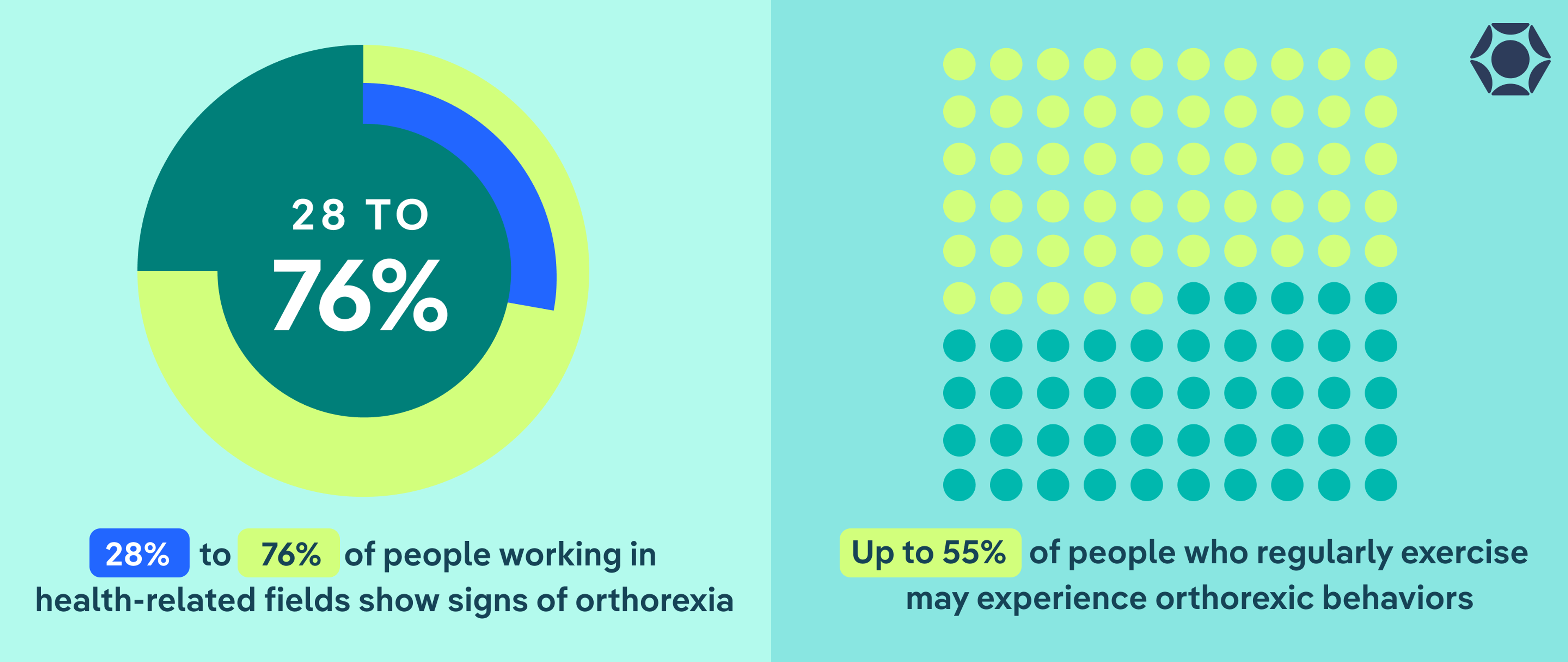
It appears even more common in health- and fitness-focused spaces, such as competitive athletics, fitness studios, and weight-loss-focused social media accounts. Per a review in the International Journal of Environmental Research and Public Health, 28% to 76% of people working in health-related fields show signs of orthorexia. A study in the Journal of Eating Disorders also found that up to 55% of regular exercisers (think: athletes, weightlifters, CrossFitters, and runners) may experience orthorexic behaviors. Bigorexia is another disordered eating pattern that can affect these communities.
Orthorexia often starts with good intentions, like wanting to feel better or improve health. “We have an issue when this behavior becomes inflexible,” says Brianna Halasa, LMHC, LPCC, a licensed psychotherapist. “People start to plan their meals to the detail, cutting out entire categories of food groups or compulsively checking ingredient lists or labels.”
These behaviors are often praised in thinness-focused Western cultures, so orthorexia can be difficult to recognize. But when food rules create distress, isolation, or harm to health, that’s a sign your relationship with food may be harmful.
Is orthorexia an eating disorder?
Orthorexia nervosa isn't currently recognized as a standalone eating disorder in the Diagnostic and Statistical Manual of Mental Disorders (DSM). However, many clinicians recognize it as a serious form of disordered eating that can affect health and quality of life.
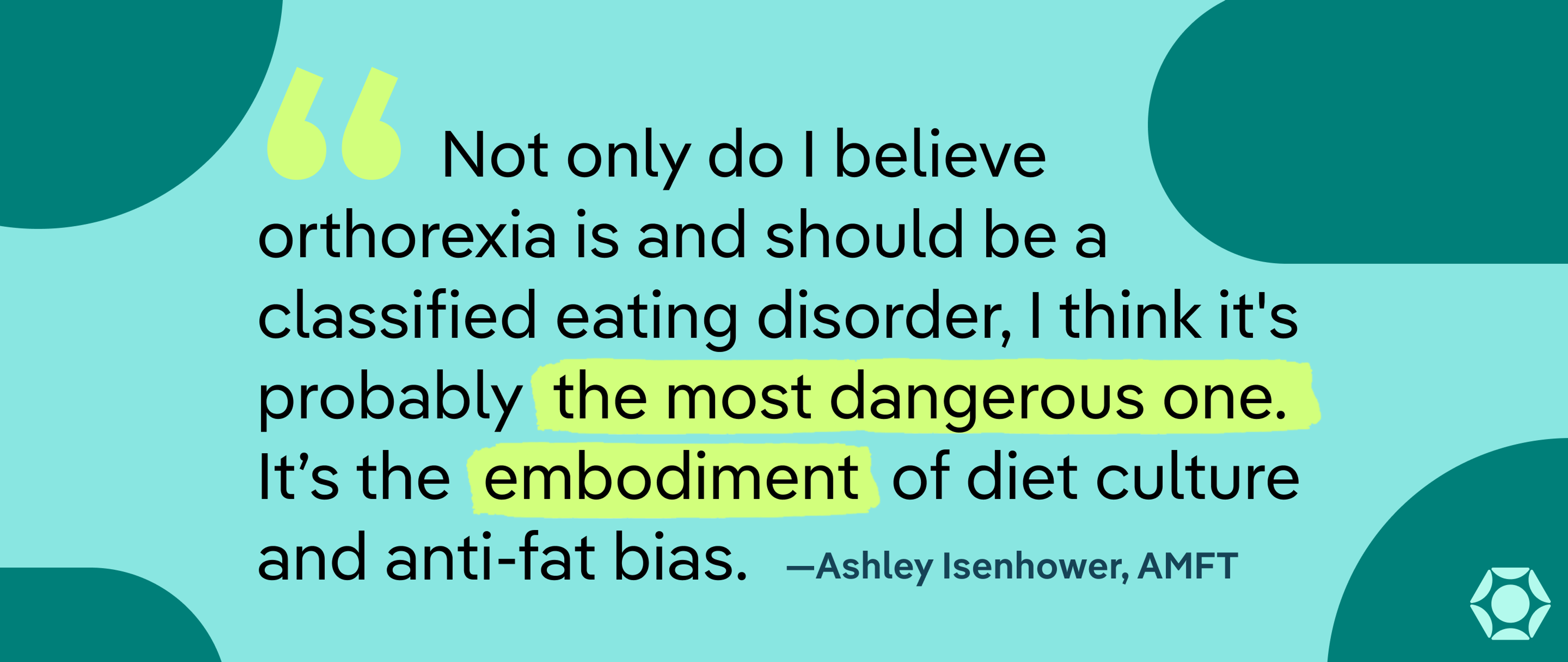
“Not only do I believe orthorexia is and should be a classified eating disorder, I think it's probably the most dangerous one,” says Ashley Isenhower, AMFT, an Equip therapist. “It’s the embodiment of diet culture and anti-fat bias.” Importantly, orthorexia symptoms aren’t any less serious or treatable because they lack a formal diagnosis.
How is orthorexia different from healthy eating?
Healthy eating | Orthorexia |
Focuses on nourishment, energy, and well-being | Focuses on food purity, rules, and “cleanliness” |
Flexible and adaptable across different situations | Rigid, rule-based, and hard to bend |
Allows for variety and enjoyment | Cuts out foods/entire food groups without medical need |
Leaves room for social eating and spontaneity | Avoides eating out/eating with others due to stress |
Food choices are guided by curiosity and balance | Food choices are driven by fear, guilt, or anxiety |
“Less healthy” foods don’t cause distress | Breaking a rule triggers shame, anxiety, or self-criticism |
Eating supports mental health and quality of life | Eating increases stress and preoccupation |
Food is one part of a full, meaningful life | Food is central to identity and daily decision-making |
“Orthorexia is a focus on healthy eating to a point that it becomes more consuming and no longer healthy,” mentally or physically, explains Stephanie Kile, MS, RDN, lead registered dietitian nutritionist at Equip. “It becomes more than just healthy eating and begins to impact all areas of life.”
In other words, healthy eating lets you make food choices without fear or guilt. With orthorexia, those choices become increasingly restrictive, and following food rules can start to feel more important than your well-being.
What are the signs of orthorexia?
The signs of orthorexia can show up in many areas of daily life, not just at meals.
Myers’ experience illustrates how far-reaching the impact can be; orthorexia can even have similar characteristics to OCD. “My life revolved around being ‘healthy,’ but I was constantly getting sick because I was not eating enough to sustain my energy needs,” she says. “I lost my menstrual cycle for many years, and orthorexia made me avoid getting help because I feared doctors would try to ‘contaminate’ me even further with medicine or chemicals.”
These signs often develop gradually, which makes them easy to overlook. One helpful way to understand orthorexia is to look at how it shows up across three areas: behavior, thoughts and emotions, and physical health.
Behavioral signs
With orthorexia, “food becomes a source of stress rather than nourishment,” says Halasa. “Think about someone who puts the pursuit of purity over relationships, joy, and overall well-being.” That shift often shows up through patterns like:
- Rigid food rules that go beyond medical needs, like cutting out entire food groups
- Compulsive checking of ingredient lists, nutrition labels, or sourcing details
- Spending excessive time planning meals, researching foods, or preparing food “correctly”
- Avoiding restaurants, social gatherings, or travel because food feels unpredictable
- Refusing to eat food others make or feeling the need to control every aspect of meals
- Exercising compulsively to “balance” or justify eating
- Increasing isolation as food rules limit daily life
Psychological signs
According to Kile, orthorexia can also involve “high levels of perfectionism” and “lack of ability to have freedom in eating,” even when body image concerns aren’t the primary focus. Other psychological signs include:
- Intense anxiety around eating foods deemed “unclean,” processed, or imperfect
- Guilt, shame, or self-criticism after breaking food rules
- Black-and-white thinking about food as good or bad
- Feeling morally superior—or deeply ashamed—based on food choices
- Constant mental preoccupation with food, ingredients, and eating decisions
- Difficulty being present or enjoying activities because of food-related worry
Physical signs
“If you are cutting out entire food groups without medical necessity, you won’t get adequate nutrition, which leads to deficiencies,” says Halasa. You may also notice other physical symptoms like:
- Unintended weight loss or difficulty maintaining weight
- Fatigue, dizziness, or low energy from inadequate intake
- Digestive issues such as constipation, bloating, or early fullness
- Hormonal disruptions, including missed periods or sleep problems
- Signs of nutrient deficiencies from restricted variety
- Worsening anxiety or depression as restriction increases
It’s also worth noting that someone with orthorexia may have a "normal" body mass index (BMI) and appear healthy. You can’t always tell from someone’s appearance if they’re struggling with orthorexia (or any other form of disordered eating, for that matter).

What causes orthorexia?
Orthorexia doesn’t come out of nowhere. It tends to grow gradually, often shaped by a combination of personality traits, stressors, and cultural messages, says Kile.
“Orthorexia is complex and shouldn’t be reduced to ‘she or he is obsessed with clean food,’” adds Halasa. For many people, food rules become a way to cope with anxiety, uncertainty, or a need for control.
Understanding these factors isn’t about blame. It’s about realizing why orthorexia takes hold—and knowing that support can help with the underlying struggles, not just the eating behaviors themselves.
Psychological factors
According to Halasa and Kile, certain mental and emotional traits can increase vulnerability to orthorexia, including:
- Perfectionism and all-or-nothing thinking
- High levels of anxiety or health anxiety
- Obsessive or compulsive traits
- A strong need for control or predictability
- History of trauma, anxiety, depression, or other eating disorders
- Poor body image, even if weight loss isn’t the original goal
Food rules can temporarily reduce anxiety, which reinforces them…until they start creating more stress than relief.
Environmental factors
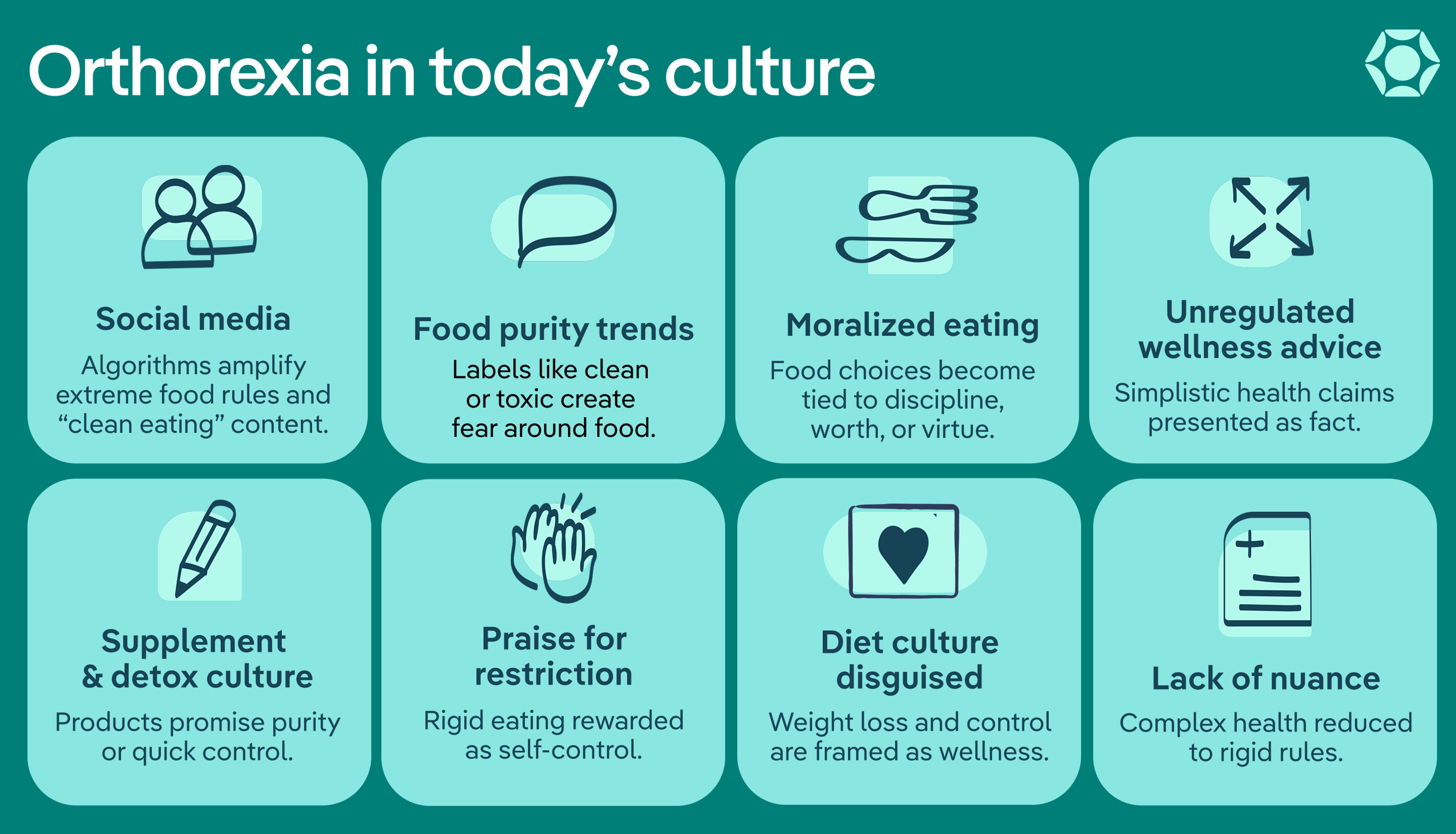
“We live in a culture that praises beauty and discipline, and often confuses wellness with worth,” says Halasa. Here are eight cultural influences that can reinforce orthorexia:
- Social media: Algorithms amplify extreme food rules and “clean eating” content.
- Food purity trends: Foods labeled as clean, toxic, or inflammatory create fear around eating.
- Moralized eating: Food choices become tied to discipline, worth, or virtue.
- Unregulated wellness advice: Oversimplified health claims are presented as universal truths.
- Supplement and detox culture: Toxic fitness culture often touts products that promise control, purity, or quick fixes.
- Praise for restriction: Rigid eating is rewarded as dedication or self-control.
- Diet culture in disguise: Weight loss and control are framed as wellness.
- Lack of nuance: Complex health topics are reduced to rigid rules.
For people dealing with trauma or chronic stress, controlling food choices may also become a way to cope. These pressures can make orthorexic behaviors feel normal—or even admirable—rather than concerning.
Biological factors
Biology can also influence risk, according to Kile. Some people may be more susceptible to orthorexia due to:
- A family history of eating disorders
- Genetic predisposition toward anxiety or obsessive traits
- Digestive conditions or chronic illness that initially require dietary changes
- A history of dieting or medically supervised food restriction
- Pre-existing / co-occuring OCD
What are the health risks of orthorexia?
Even when food choices look “healthy” on the surface, orthorexia can take a serious toll on physical and mental health. These risks don’t come from eating the “wrong” foods; instead, they stem from chronic restriction, stress, and a lack of flexibility around eating.
According to Halasa and Kile, common health risks of orthorexia include:
- Malnutrition and nutrient deficiencies: Cutting out entire food groups without medical necessity can increase your risk for nutrient deficiencies.
- Hormonal disruptions: Inadequate intake can affect hormone production, leading to missed periods, fertility issues, sleep problems, and blood sugar instability.
- Digestive problems: Restriction can slow digestion and contribute to constipation, bloating, nausea, and early fullness.
- Cardiovascular and metabolic effects: Malnutrition can lower your heart rate and cause dizziness, fatigue, and low blood pressure.
- Worsening mental health: Orthorexia is closely linked to anxiety, depression, and obsessive thinking.
- Social withdrawal and isolation: Avoiding meals with loved ones can strain relationships and reduce social support, which is critical for mental health and recovery.
- Increased risk of other eating disorders: Orthorexia can overlap with or progress into other eating disorders like anorexia or binge eating disorder.
- Delayed or avoided medical care: Some people with orthorexia distrust medical guidance, which can delay diagnosis and treatment.
How is orthorexia diagnosed?
Orthorexia nervosa doesn't have formal diagnostic criteria in the DSM-5-TR, so there's no single test that can diagnose it. Instead, clinicians assess a person's eating habits, thoughts about food, and how those behaviors affect their health and daily life.
Researchers have proposed criteria to help identify orthorexia. For example, a 2016 review in Eating Behaviors describes two key features:
- An obsessive focus on eating foods perceived as healthy, often accompanied by rigid food rules, anxiety about food choices, and increasing restrictions.
- Significant consequences, such as nutritional deficiencies, emotional distress, social isolation, or difficulty functioning in everyday life.
A comprehensive eating disorder assessment can help clinicians better understand what's driving someone's behaviors and whether they meet the criteria for an existing diagnosis, such as other specified feeding or eating disorder (OSFED), anorexia nervosa, or obsessive-compulsive disorder (OCD).
In some cases, providers may even recommend a diagnosis like OSFED to reflect the seriousness of someone's symptoms, says Isenhower. A recognized diagnosis can also guide treatment and make it easier to access care through insurance.
Clinicians may also use screening questionnaires, such as the ORTO-15 or Düsseldorf Orthorexia Scale, to identify potentially concerning eating patterns. These tools can't diagnose orthorexia on their own, though, and they're not always accurate. For example, some may flag people who follow specific diets for religious, ethical, or medical reasons, even when those eating patterns aren't causing distress or harm.
The most important thing to know is that you don't need an official orthorexia diagnosis to deserve or receive care. If food rules are interfering with your life, an assessment can help you understand what's happening and what kind of support might help.
How is orthorexia different from anorexia and OCD?
Orthorexia centers on the perceived quality or purity of food, while anorexia nervosa involves restricting food intake, often driven by an intense fear of weight gain or concerns about body image.
Still, the two can be connected. Someone with orthorexia may eliminate so many foods that they're no longer getting enough nutrition, similar to what can happen with anorexia. The conditions can also overlap, and some people may develop symptoms of anorexia as their food restrictions intensify.
Orthorexia also shares features with OCD. Both can involve intrusive thoughts, anxiety, and repetitive behaviors intended to relieve that anxiety. For someone with orthorexia, those behaviors might include repeatedly checking ingredient labels, researching food safety, or following strict meal preparation rituals. However, OCD and eating disorders are distinct conditions, even when their symptoms look similar.
Here's how the three compare:
Orthorexia | Anorexia | OCD | |
Main focus | Eating foods perceived as healthy, clean, or pure | Restricting food intake, often related to weight or body image | Managing intrusive thoughts, fears, or uncertainty |
Role of body weight or shape | Not necessarily a primary concern | Typically central to the disorder | Not typically central, though obsessions can involve weight or appearance |
What drives the behaviors | Fear of unhealthy or impure foods | Fear of weight gain and distorted perceptions of weight or shape | Anxiety or distress related to obsessions, often relieved temporarily through compulsions |
Formal diagnosis status | Not a DSM-5-TR diagnosis | Recognized eating disorder | Recognized mental health condition |
Common treatment approaches | Eating disorder therapy, nutrition support, and exposure-based strategies | Eating disorder therapy, nutrition rehabilitation, and medical monitoring | Cognitive behavioral therapy, particularly exposure and response prevention |
These distinctions can help explain what you're experiencing, but they aren't always clear-cut. You might recognize yourself in more than one description, or none. What matters most is how your thoughts and behaviors around food affect your life, not finding a perfect label.
When should you seek help for orthorexia?
If you're struggling with food, you don't have to wait until things feel “serious enough” to ask for help. This can be especially hard to recognize with orthorexia, since many of the behaviors are praised as healthy or disciplined. But if your relationship with food is causing distress or interfering with your life, that's reason enough to seek support.
According to Kile and Halasa, it’s time to reach out if you notice:
- Food taking up a lot of mental space or causing ongoing worry
- Feeling anxious, guilty, or distressed around meals
- Pulling back from social plans, travel, or shared eating
- Experiencing physical changes like low energy, digestive issues, dizziness, or missed periods
- Struggling to eat enough to feel nourished or function well
- Feeling stuck in rules that are no longer helpful, even if you want things to change
Keep in mind that you don't need to experience all of these signs to benefit from support. And if you're experiencing a medical or mental health crisis, seek immediate help from emergency services, this crisis support line, or this eating disorder support line.
What does orthorexia treatment look like?
Orthorexia treatment focuses on helping people build a more flexible, less stressful relationship with food and health, says Halasa. This might involve gradually reintroducing foods that once felt off-limits, becoming more comfortable eating in social settings, and finding ways to manage anxiety without relying on strict food rules.
Because research on orthorexia-specific treatment is still limited, clinicians often draw on approaches used to treat other eating disorders and OCD, such as:
- Cognitive behavioral therapy (CBT): Helps people identify and challenge rigid beliefs about food and develop more flexible ways of thinking and eating.
- Exposure-based therapy: Involves gradually facing feared foods or eating situations (with support) to help reduce anxiety and the urge to follow rigid rules or rituals.
- Acceptance and commitment therapy (ACT): Helps people make room for uncomfortable thoughts and feelings without letting them dictate food choices, while building habits that align with their personal values.
Treatment also addresses concerns like anxiety, perfectionism, trauma, or co-occurring eating disorders that may contribute to orthorexic behaviors. That's why care often involves a coordinated team, including:
- Therapists, who help address the thoughts, emotions, and behaviors driving food-related anxiety and restriction. They also help you develop coping skills that don't revolve around controlling food.
- Dietitians, who help restore adequate nourishment, expand food variety, and challenge food myths without shame or judgment. Working with an eating disorder-informed, weight-inclusive dietitian like those at Equip can be especially helpful.
- Medical providers, who monitor physical health and address complications such as malnutrition, nutritional deficiencies, or hormonal changes.
The right level of care depends on how much symptoms affect your health and daily life. Some people can recover with outpatient treatment. Others may benefit from more structured support, such as intensive outpatient or partial hospitalization programs. Inpatient or residential treatment may be needed when someone is medically unstable.
How can I support a loved one with orthorexia?
Supporting someone with orthorexia can feel complicated. What matters most is approaching the situation with empathy, curiosity, and care.
How to start a conversation about orthorexia
Starting from concern and observation—not criticism—can help a loved one feel safer opening up. Cohen recommends gentle, open-ended questions like:
- I’ve noticed food seems more stressful lately. How has eating been feeling for you?
- Do these habits feel supportive, or do they feel heavy or overwhelming?
- How are you feeling emotionally around food right now?
- Does anxiety around eating ever feel like it’s getting in the way of your well-being?
Avoid reinforcing harmful behaviors
Even well-meaning comments can unintentionally reinforce orthorexic patterns, says Myers. Try to avoid:
- Praising restriction or “discipline” around food
- Commenting on how healthy, clean, or pure someone’s eating looks
- Comparing your eating habits to theirs
- Turning concern into a debate about nutrition facts
Encourage support early and gently
If you or someone you love is showing signs of disordered eating or an eating disorder, support is out there to help prevent patterns from becoming more entrenched.
Equip provides tailored eating disorder treatment that includes a coordinated care team and mentors who have been through similar experiences. They can help with orthorexia, and you don’t need a formal diagnosis to get started. Schedule a free consultation to learn more.
The bottom line
Orthorexia can be hard to recognize because it often looks like “doing everything right.” But when eating becomes rigid, anxiety-driven, or isolating, it can take a toll on your physical and mental health.
You don't need a formal diagnosis—or to reach a breaking point—to ask for help. With compassionate, multidisciplinary care, recovery is possible, and you can work toward a more flexible, peaceful relationship with food and health.
FAQ
Is orthorexia a type of OCD?
No, orthorexia isn't a type of OCD, but the two can overlap. Both can involve obsessive thoughts, compulsive behaviors, and anxiety, though orthorexia specifically centers on food quality and purity.
Can orthorexia turn into anorexia?
Yes, orthorexia and anorexia can overlap, and some people with orthorexia may develop symptoms of anorexia as their food restrictions become more severe. However, this isn't inevitable, and not everyone with orthorexia experiences the weight or body image concerns associated with anorexia.
Who is most affected by orthorexia?
Orthorexia can affect anyone, though research has frequently focused on athletes, health and fitness professionals, and people involved in wellness culture. Environments that emphasize strict eating habits, body composition, or compulsive exercise may reinforce orthorexic behaviors, but it's not yet clear whether these groups are at greater risk than the general population.
What happens if orthorexia goes untreated?
Without support, orthorexia can contribute to nutritional deficiencies, physical health problems, worsening anxiety, and social isolation. Food restrictions may also become more rigid over time, making it harder to maintain adequate nutrition and participate in everyday activities.
Atchison, Anna E, and Hana F Zickgraf. “Orthorexia nervosa and eating disorder behaviors: A systematic review of the literature.” Appetite vol. 177 (2022): 106134. doi:10.1016/j.appet.2022.106134
Balasundaram, Palanikumar, and Prathipa Santhanam. “Eating Disorders.” National Library of Medicine, StatPearls Publishing, 2023, www.ncbi.nlm.nih.gov/books/NBK567717/.
Brock, Hannah, et al. “Obsessive-Compulsive Disorder (OCD).” PubMed, StatPearls Publishing, 2024, https://www.ncbi.nlm.nih.gov/books/NBK553162/. Accessed 19 Oct. 2026.
Carlson, Jennifer L, and Diana C Lemly. “Medical Considerations and Consequences of Eating Disorders.” Focus (American Psychiatric Publishing) vol. 22,3 (2024): 301-306. doi:10.1176/appi.focus.20230042
Costandache, Gina I et al. “An overview of the treatment of eating disorders in adults and adolescents: pharmacology and psychotherapy.” Postepy psychiatrii neurologii vol. 32,1 (2023): 40-48. doi:10.5114/ppn.2023.127237
Dunn TM, Bratman S. On orthorexia nervosa: A review of the literature and proposed diagnostic criteria. Eat Behav. 2016 Apr;21:11-7. doi: 10.1016/j.eatbeh.2015.12.006. Epub 2015 Dec 18. PMID: 26724459.
Hafstad, Stine Marie et al. “The prevalence of orthorexia in exercising populations: a systematic review and meta-analysis.” Journal of eating disorders vol. 11,1 15. 6 Feb. 2023, doi:10.1186/s40337-023-00739-6
Horovitz, Omer, and Marios Argyrides. “Orthorexia and Orthorexia Nervosa: A Comprehensive Examination of Prevalence, Risk Factors, Diagnosis, and Treatment.” Nutrients vol. 15,17 3851. 3 Sep. 2023, doi:10.3390/nu15173851
López-Gil, José Francisco et al. “Overall proportion of orthorexia nervosa symptoms: A systematic review and meta-analysis including 30 476 individuals from 18 countries.” Journal of global health vol. 13 04087. 3 Nov. 2023, doi:10.7189/jogh.13.04087
McInerney, Ellie G et al. “A Systematic Review on the Prevalence and Risk of Orthorexia Nervosa in Health Workers and Students.” International journal of environmental research and public health vol. 21,8 1103. 21 Aug. 2024, doi:10.3390/ijerph21081103
Mitrofanova, Elina et al. “Does ORTO-15 produce valid data for 'Orthorexia Nervosa'? A mixed-method examination of participants' interpretations of the fifteen test items.” Eating and weight disorders : EWD vol. 26,3 (2021): 897-909. doi:10.1007/s40519-020-00919-2
Moore, Christine A, and Brooke R Bokor. “Anorexia Nervosa.” National Library of Medicine, StatPearls Publishing, 2023, https://www.ncbi.nlm.nih.gov/books/NBK459148/. Accessed 19 Oct. 2026.
Yılmaz, Hamdi et al. “Association of Orthorexic Tendencies with Obsessive-Compulsive Symptoms, Eating Attitudes and Exercise.” Neuropsychiatric disease and treatment vol. 16 3035-3044. 14 Dec. 2020, doi:10.2147/NDT.S280047